


The fifth State of the Nation Address was a eulogy delivered to a nation still fighting to stay alive.
On July 27, President Ferdinand Marcos Jr. opened his address by touting his administration’s reforms and the nearly ₱25 billion in assets recovered, frozen, or preserved in connection with the flood-control scandal. Yet the government cannot present the recovery of what should have remained with the people as a triumph. It is not extraordinary governance; it is the bare minimum owed by a government entrusted with public money and the people’s welfare.
“Hindi ako pangulo ng aking pamilya. Hindi ako pangulo ng aking kaibigan. Ako ay pangulo ng Pilipinas, at ang tungkulin ko ay sa inyo,” Marcos declared as he announced that cases against those implicated—including his cousin, former House Speaker Ferdinand Martin Romualdez—would proceed.
But accountability loses its force when it comes only after public money disappears, infrastructure fails, and communities drown. To those spared from the consequences, the declaration may sound decisive. To Filipinos who have endured flooded homes, crumbling infrastructure, and years of government neglect, it is merely a bandage pressed against a wound the government allowed to deepen. A bandage may hide the blood, but it cannot heal the wound.
For years, the government has answered the hardships of Filipinos not with lasting solutions but with neglect, until suffering itself became an ordinary way of life. Floodwaters continue to invade homes whenever rain falls; communities face displacement through land conversion; and even the country’s education system remains burdened by chronic underfunding. The president’s support for Pax Silica, paired with his silence on urgent structural reforms for the Department of Education (DepEd), Commission on Higher Education (CHED), and Technical Education and Skills Development Authority (TESDA), only deepens this cycle of neglect.
The administration presented its achievements as consolation for a nation still burdened by unresolved suffering. It spoke as though accomplishments within the halls of government could comfort people still living with the consequences of its failures. The address, then, revealed only a fraction of the nation’s true condition—the fraction the administration wanted the public to see.
A SONA cannot exist merely to enumerate achievements. It must confront the failures of flood-control projects, not merely report recovered funds; safeguard the communities that have nurtured the land for generations, not leave them displaced; commit to urgent structural reforms in education, not remain silent about them; and address the many struggles that remain outside the halls of government. To emphasize accomplishments alone while overlooking suffering is to abandon the very purpose of the address: to reflect the nation as it truly is, not merely as the administration hopes it will be remembered.
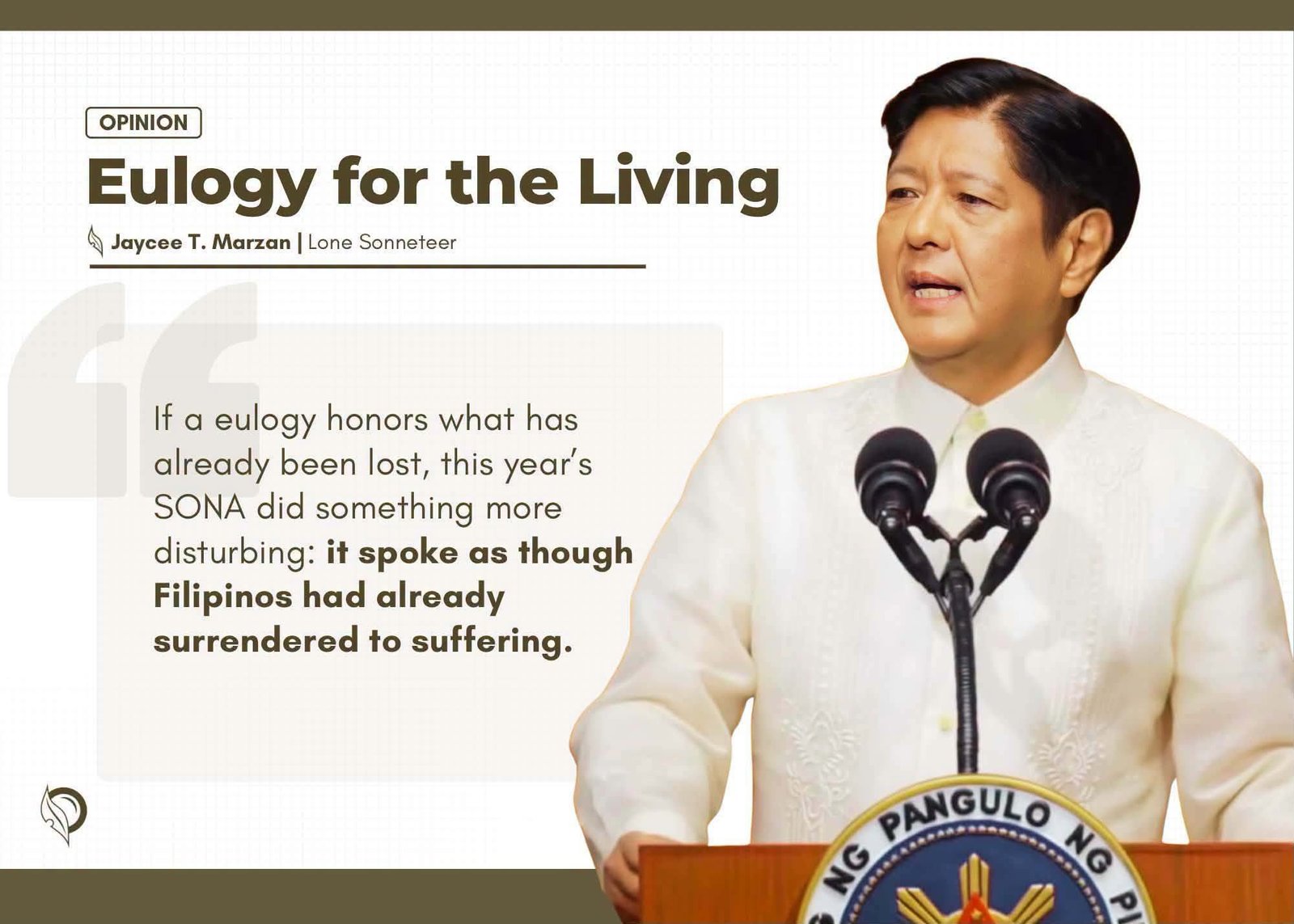
If a eulogy honors what has already been lost, this year’s SONA did something more disturbing: it spoke as though Filipinos had already surrendered to suffering. It treated endurance as recovery and survival as progress, even while millions waited for proof that their country was not beyond saving.
The Philippines is not dead. Its people are still fighting to live. They deserve more than a government that narrates their suffering after the damage is done. They deserve one that stops the bleeding before it writes the funeral rites.#
Words by Jaycee T. Marzan
Layout by Ralph Louie A. Mateo
#TheUniversityScribe
#21YearsOfImmutablePassion
#InscribingPerspectives



Create an Account
Choose your account type
Comments (0)
No comments yet. Be the first to share your thoughts!